
In a case fraught with all the hallmarks of a wrongful conviction, Charles has maintained his innocence and been denied a new trial.
Charles Don Flores’s wrongful conviction is a result of an identification made long after the crime by a witness who had repeatedly failed to identify Mr. Flores and described seeing two perpetrators who looked nothing like him. Her identification of Mr. Flores was made for the first time mid-trial, after she had been subjected to “investigative hypnosis” and after she had been exposed, on multiple occasions, to Mr. Flores’s photo.
The fruits of investigative hypnosis are now banned from Texas criminal trials because it is junk science. But Mr. Flores remains on death row and is at serious risk of execution because no court has yet considered the evidence of a profoundly corrupted trial.
Immediately After the Crime, the Eyewitness Described Two Perpetrators who looked nothing like mr. flores
In January 1998, Betty Black was shot and killed in her Farmers Branch home during an attempted robbery.
The morning of the crime, Mrs. Black’s next-door neighbor, the eyewitness, told police she had seen two white males with similar builds and long hair exiting a Volkswagen Beetle and entering the garage early that morning.
Mr. Flores is Hispanic, always had short, shaved hair, and looked nothing like the suspect who was immediately identified as the owner/driver of the distinctive “hippie” purple and pink Volkswagen Beetle, which several neighbors had observed in the Blacks’ driveway the morning she was shot.
The car’s owner was Richard Childs, a white male with long, dirty hair with a tall, slim build. On the day of the crime, the eyewitness easily identified Childs as the driver she had seen getting out of the Volkswagen in her neighbor’s driveway.

On the left is the computer-generated composite sketch that the eyewitness created at the police department. On the right is the picture of Charles police presented to her in a photo lineup.
Childs, a local drug addict and dealer, had been seen repeatedly in the Blacks’ neighborhood in his distinctive car. He was having an affair and doing drugs with the Blacks’ daughter-in-law, who gave him information about how to access the Blacks’ house and told him where she believed her imprisoned husband, the Blacks’ son, had stashed drug proceeds she believed she had a claim to.
Law Enforcement Accuse Mr. Flores Despite the Eyewitness Descriptions and lack of any direct evidence linking him to the crime
Despite the eyewitness’s description of someone who did not resemble Mr. Flores in any way and her failure to pick him out of a photo lineup, the Dallas County District Attorney’s Office nevertheless charged Mr. Flores with capital murder.
Despite Mr. Flores’s consistent claim of innocence, the Dallas County District Attorney’s Office sought the death penalty.
No DNA, ballistics, fiber, or fingerprint evidence ever connected Mr. Flores to the crime scene.
After “Investigative Hypnosis” and Repeatedly Seeing Mr. Flores’ Photo Identified as the Suspect, the Eyewitness Identified Him at Trial.
During Mr. Flores’s trial, over a year after describing having seen two white males with long hair who looked “similar” to one another, Mrs. Black’s neighbor claimed for the first time that Mr. Flores was one of the men she had seen that morning.
The eyewitness’s purported identification, it turned out, was the product of “investigative hypnosis.”
Following her initial descriptions, the witness was put into a trance at the police station by a police officer who had never tried this procedure before—and never did so again.
A videotape was made of the bizarre proceeding by one of the lead detectives on the case who knew that Mr. Flores was law enforcement’s preferred suspect.
During the hypnosis session, the witness described the car’s driver as having “long, wavy” dark blonde hair.
The hypnotist then asked her about the passenger and urged her to focus on his hair. She said it was “a lot like his friend’s” and clarified: “dark, long.” The hypnotist persisted: “Just relax, take a deep breath, take the time you need. Can you tell me how long his hair is? Does he have it neatly cut or is it trimmed?” Again, the witness said the man had long hair: “I see it to his shoulders.”
Before bringing her out of hypnosis, the examiner told her: “you might find yourself being able to recall other things as time moves on.”
Importantly, the jury that convicted Mr. Flores and sentenced him to death never saw the video of the hypnosis session.
Watch the ‘forensic hypnosis’ session that the jury never saw.
The jury was never told that, during the hypnosis session, the police raised the idea of someone with “short” “shaved” or “trimmed” hair after the witness had said the hair for both men was long.
Right after the hypnosis session, police showed the witness a suggestive six-photo lineup featuring only Hispanic males with short, shaved hair—with Flores’s recent photo prominently displayed in the center, the only person wearing a colorful shirt and with an eye-catching background. But the witness failed to pick him (or anyone) out, likely because no one resembled the descriptions she had repeatedly provided to the police.
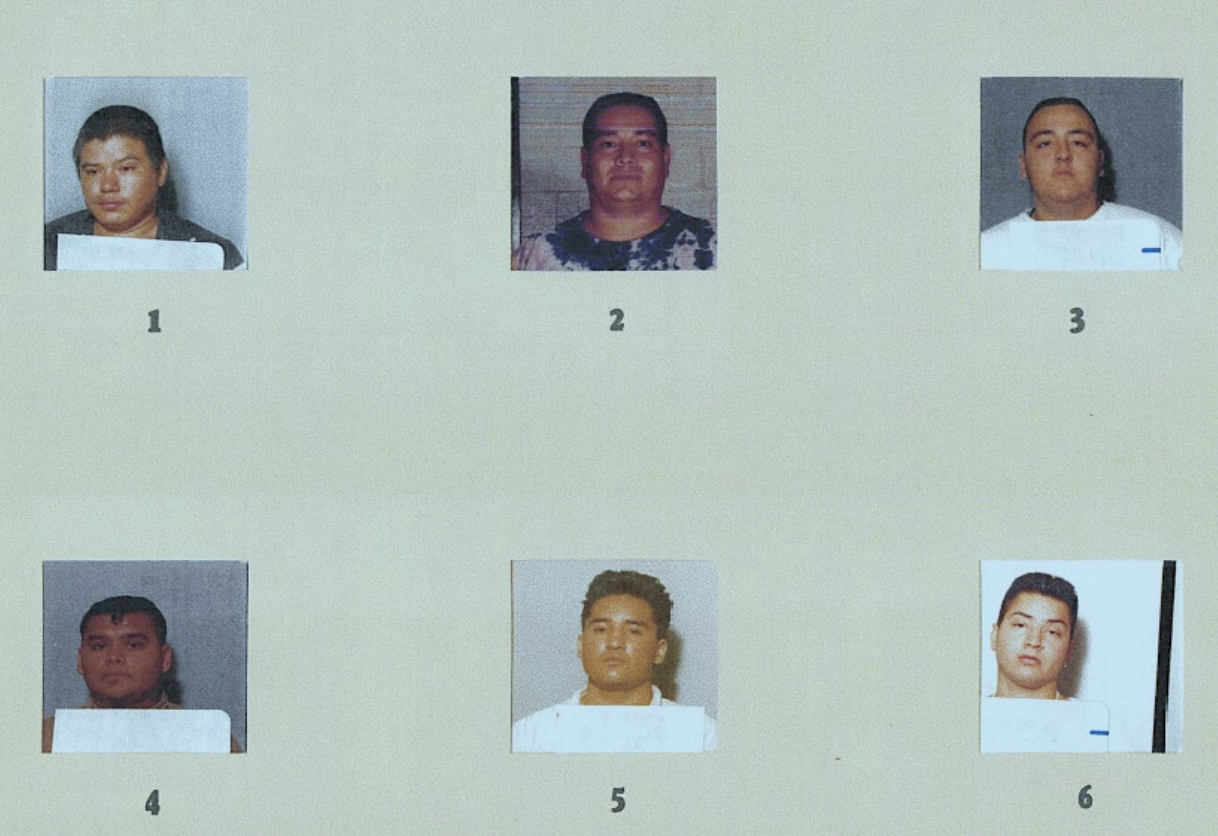
The suggestive six-photo line up, with Charles’ photo prominently displayed.
The witness’s failure to identify Mr. Flores is a fact that experts in eyewitness identification today see as highly probative evidence of Mr. Flores’s innocence.
That same day, the eyewitness produced a composite drawing of Childs’ companion, depicting a white man with long, stringy brown hair and a narrow face who looked nothing like Mr. Flores, though he did resemble Childs.
The eyewitness easily identified Richard Childs as the car's driver out of a photo lineup. On this same day, the eyewitness never claimed that she saw a Hispanic male with the car's driver.
The witness only identified Mr. Flores during his trial, 13 months later, after his photograph had been in the media for months, and after she saw him sitting at the defense table, the only Hispanic person in the entire courtroom.
Eyewitness Misidentification is a Leading Cause of Wrongful Convictions:

Eyewitness misidentification is one of the leading causes of wrongful convictions in the United States.
According to the National Institutes of Health, up to 75% of wrongful convictions overturned through DNA evidence have involved erroneous eyewitness identifications.
With 67 documented exonerations, Dallas County is among the five counties with the most exonerations (and thus the most wrongful convictions). A number of these exonerations have resulted from the work of Conviction Integrity Units (CIU). The first CIU in the country was created in Dallas in 2007 under the leadership of then-District Attorney Craig Watkins. Many of the wrongful convictions that led to exonerations involved flawed eyewitness identification testimony and prosecutorial misconduct, both of which are evident in the Flores case.
The Texas Legislature Has Outlawed the Use of Hypnotically Induced Testimony Like That Used in Mr. Flores’s Case.
Texas lawmakers now recognize that “investigative hypnosis” is so unreliable the fruits of it cannot be used in criminal trials.
In 2023, inspired in part by Mr. Flores’s case, the Texas Legislature passed Senate Bill 338, which bars the admissibility of hypnotically refreshed testimony pertaining to the offense that is the subject of the trial.
That change in Texas law provides: “all statements made during or after a hypnotic session by a person who has undergone investigative hypnosis performed by a law enforcement agency for the purpose of enhancing the person’s recollection of an event at issue in a criminal investigation or case, including courtroom testimony regarding those statements and including statements identifying an accused that are made pursuant to pretrial identification procedures are not admissible against a defendant in a criminal trial, whether offered in the guilt or innocence phase or the punishment phase of the trial, if the hypnotic session giving rise to the statement was performed by a law enforcement agency to investigate the offense that is the subject of the trial.” Tex. Code. Crim. Proc. art. 38.24 (b) &(c) (added by Acts 2023, 88th Leg., R.S., Ch. 1028 (S.B. 338), Sec. 1, eff. September 1, 2023) (emphasis added).
Even though the injustice in Mr. Flores’s case inspired this important change in Texas law, the courts have refused to reconsider the role junk science played in his wrongful conviction, and he remains at risk of execution for a crime that someone else committed.
In 2024, the New York Times released an opinion video about the problematic role of “investigative hypnosis” to obtain Mr. Flores’s wrongful conviction:
No Court Has Considered the Core Injustice in Mr. Flores’s Case.
No court has ever considered the large body of suppressed evidence exposing that the State’s entire case was saved, mid-trial, by the hypnotized witness.
The Texas Court of Criminal Appeals has so far refused to consider the new evidence after finding an unexplained “procedural bar” and dismissing the case without considering the merits of Mr. Flores’s claims, including his actual innocence claim.
The CCA also has refused to consider the incompatibility of a conviction and death sentence dependent on the junk science of “investigative hypnosis” even as current Texas law bans reliance on testimony obtained from that form of witness-tampering.
Mr. Flores’s Case Was Marred by Rampant Misconduct.
Like other Texas death penalty cases that have come under scrutiny in recent years, Mr. Flores’s wrongful conviction and death sentence were achieved through a combination of junk science—the use of “investigative hypnosis”—and significant prosecutorial misconduct.
The trial transcripts make clear that the State’s case was saved by and depended on the hypnotized witness identifying Mr. Flores.
The prosecution also argued, unequivocally, that Mr. Flores shot and killed Betty Black, but the prosecutors knew this was false.
Before Mr. Flores’s trial, Childs’ accomplice—the Blacks’ daughter-in-law—had told the lead prosecutor that Childs had admitted that he shot Mrs. Black.
This same prosecutor entered into a secret plea deal with Childs, which required admitting that he had been the shooter. The plea deal was only made public a year after Mr. Flores had been sent to death row following a shocking trial featuring an array of legally compromised “snitches” and Childs’ principal accomplice (the Blacks’ daughter-in-law) who had been given undisclosed promises of leniency in exchange for their testimony.
No credible evidence linked Flores to the crime other than the mid-trial “epiphany” of the hypnotized eyewitness.
Notably, Childs, although the shooter, was rewarded with a sweetheart deal without even having to testify against Mr. Flores.
Neither Mr. Flores’s lawyers nor the jury were told about Childs’ plea deal.
The jury was not aware that Childs was the son of a local police officer and that both he and his brother seemed to be informants for narcotics investigators with the Farmers Branch police department that investigated Mrs. Black’s murder.
The jury was not told that when Childs was arrested, he had an opened box of the exact brand and caliber of ammunition as the ballistics evidence showed had been used to kill Mrs. Black.
Thanks to his secret deal, Ric Childs served little more than 15 years in prison before being paroled. Mr. Flores still faces execution, and Childs’ real accomplice has never been identified.
The prosecution also threatened several of Mr. Flores’s friends and family members to try to obtain inculpatory testimony.
One of them, who was facing drug and weapons charges, was threatened after being kept up for days. He was eventually given an undisclosed deal dismissing all charges against him in exchange for giving a false statement claiming that Mr. Flores had admitted to being present and shooting the Blacks’ dog.
This witness has long since recanted his coerced statement.
The prosecutor also repeatedly arrested and threatened Mr. Flores’s fiancée with prosecution so that she would not testify that he was with her in Irving, Texas when Mrs. Black’s home in Farmers Branch was invaded and thus could not have committed the murder.
As in other cases where attorneys and lawmakers have sought to shine a light on and correct injustice, the State has doubled down, claiming there is other evidence connecting Mr. Flores to the murder and that his conviction does not rest solely on the testimony of a hypnotized witness. That is simply untrue.
The State’s narrative has continuously shifted over the years to try to cling to a patently unjust conviction as each component of its facially weak case has been exposed as patently unreliable.
Charles Flores Has Turned His Anguish Over His Wrongful Conviction Into Inspiration.
Mr. Flores has never denied that he knew Childs or that he was involved in drug activity at that time. But there was no evidence that Mr. Flores had any connection to Mrs. Black, had any interest in harming her, or knew anything about her death until several days later—upon learning that police were looking for the purple and pink Volkswagen that Childs had asked to leave outside of Mr. Flores’s trailer home in Irving, Texas.
Had Mr. Flores known anything about Childs using that distinctive car to perpetrate a crime, he would not have casually allowed Childs to leave that car outside of the home Mr. Flores was sharing with his fiancée and her three young daughters.
Mr. Flores has always maintained that he was at home with his fiancée when the crime took place and learned what Childs had done only after Childs was arrested.
During the 26 years he has spent on death row, Mr. Flores has steadfastly maintained his innocence but expresses deep regret for the mistakes he made in his youth, including being involved in narcotics, which put him in contact with people like Childs.
Mr. Flores has grappled with the damage resulting from his panic upon learning that he was being framed for Mrs. Black's murder, including attempting to burn Childs' distinctive car after realizing Childs had purposefully left the car at Mr. Flores's home, and trying to escape from a hospital following his arrest.
Mr. Flores has long since eschewed the addiction that began when he was introduced to substance abuse by his older brothers when he was a mere child and has fully reaffirmed the Christian faith of his childhood.
Mr. Flores is a graduate of death row’s very first faith-based program in which he was a group leader. He has especially loved learning and teaching spirituals and hymns, reminding him of happier times in childhood when he attended Church of Christ services with his parents and admired his father’s commitment as a deacon who taught Mr. Flores how to humble himself through the years of incarceration.
Mr. Flores is the founder of a book club, “Words That Sustain Me,” and is also recognized as a knowledgeable and passionate sports fan. How he has managed to follow his beloved Dallas Cowboys while in solitary confinement on Texas’s death row is the subject of an hour-long video podcast from Pablo Torre, recently nominated for a prestigious Peabody Award.